After the price of a solar plant, batteries are the question we hear most often: the sun shines by day, we need power in the evening too, so why not store the surplus? The honest answer is “it depends” — but not at random. A battery pays when it solves a specific problem that shows up on your bill or in your business risk. Below we cover those problems, the technical basics and the cases where a battery simply doesn’t pay.
What a battery actually does alongside a solar plant
A battery system next to a solar plant can take on one or more roles:
- Higher self-consumption — daytime surplus is stored and used later instead of being exported to the grid.
- Peak shaving — the battery discharges at moments of highest load, trimming the peaks that determine billed demand.
- Backup power — critical loads keep running when the grid goes down.
- Load management — for example, coordinating with EV chargers, heat pumps or production processes with short, high peaks.
Each role calls for different sizing and control; a battery “for everything” is rarely optimal for any of them.
Self-consumption: where the numbers usually break down
This is the most talked-about role and the one with the weakest economics. The reason is how surplus is settled. In the Federation of BiH, households up to 10.8 kW can choose net metering, while other prosumers, including businesses, are on net billing. For the details, see our article on prosumers in FBiH and RS.
For battery economics one thing matters: what a stored kWh is worth compared with a kWh you would otherwise export.
- Under net metering, surplus is carried forward as a kWh credit. Within the billing period the grid effectively acts as a free “battery”, so a physical battery adds little or no financial benefit.
- Under net billing, surplus is worth somewhat less than purchased energy. The battery then earns only that difference, minus its own charge and discharge losses. For most businesses that alone is not enough to recover the investment in a reasonable time.
This changes if the rules change, if the plant generates much more than the building uses in a year (so surplus is lost), or if it is built outside the prosumer regime. Regulations change — always run the numbers against the current rules.
For businesses, the better route is to size the plant to the daily load profile, as described in our guide to commercial solar, and to consider a battery only when there is another, stronger reason.
Peak shaving: the most common good reason for businesses
Many businesses on medium voltage or in higher tariff groups also pay for billed demand — typically set by the highest average load in a 15-minute interval during the month. A short peak, such as compressors, furnaces or chillers starting at the same time, can set the demand charge for the whole month. Whether and how demand is charged depends on your tariff group and contract, so we check the bill first (our guide on how to read your electricity bill helps).
Solar alone does not guarantee lower peak demand — the peak may come early, late or on a cloudy day. A properly controlled battery can:
- discharge when load exceeds a set threshold,
- charge from the solar plant or the grid during low-load periods,
- keep capacity in reserve for peaks rather than emptying itself earlier in the day.
For this role, the battery system’s power in kW and the duration of the peaks are decisive. If peaks last a few minutes, a relatively small capacity can deliver good results; if they last hours, more capacity is needed and the economics get harder.
Alongside peak demand it is worth checking reactive energy. When a solar plant covers a large share of active energy, the power factor at the metering point can deteriorate. Some battery and hybrid inverters can supply reactive power, but this depends on the model and settings and usually does not replace dedicated reactive power compensation. More in our article on reactive power compensation.
Backup power: grid-tied, hybrid and island operation
A common misconception is that a solar plant “keeps the lights on” during a power cut. A standard grid-tied inverter switches off automatically when the grid fails — a mandatory protection (anti-islanding) so that the plant does not energise a line that the operator’s crews are working on.
Backup power requires:
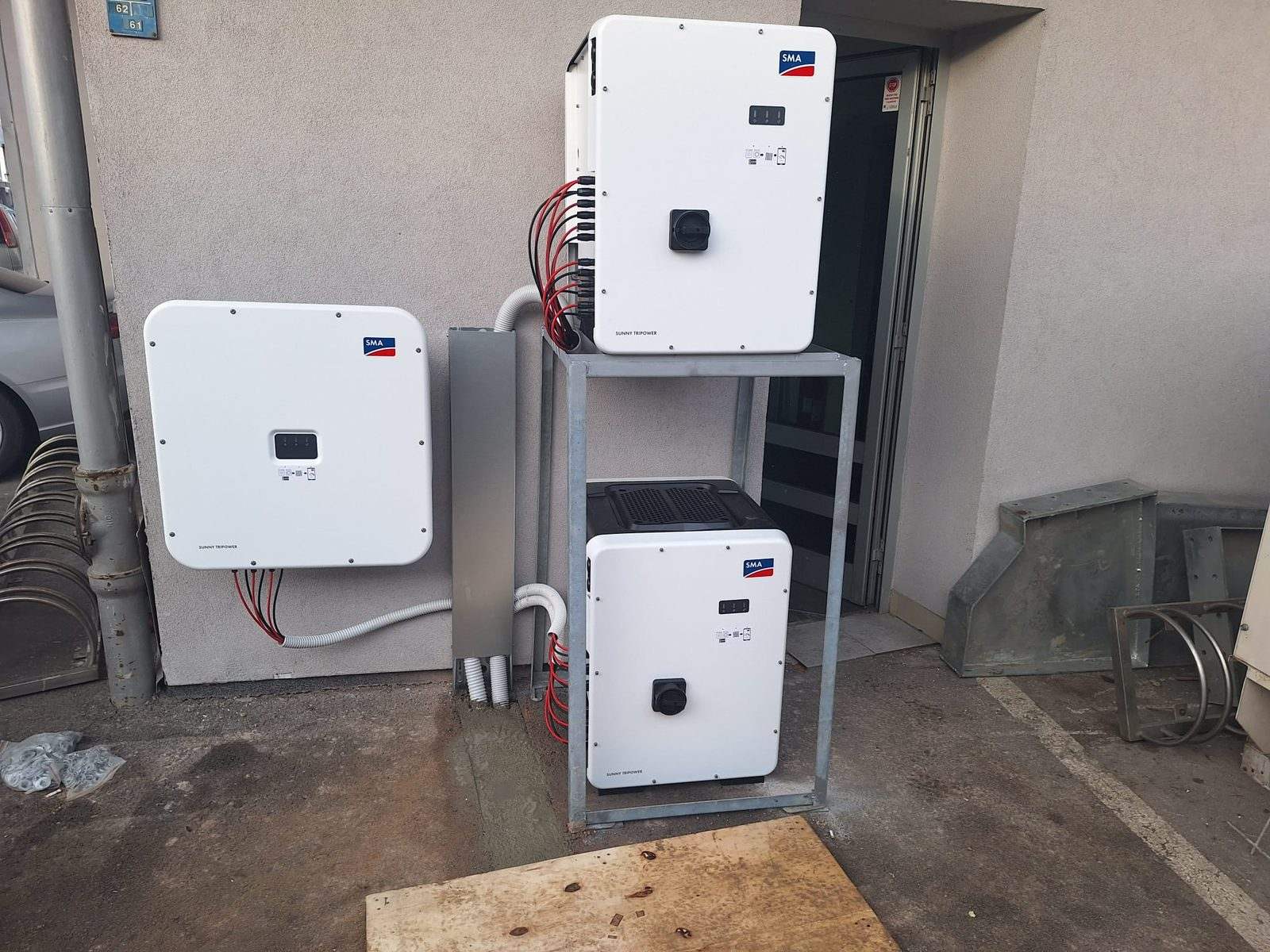
- a hybrid inverter or a battery inverter with a backup function,
- a battery,
- a grid isolation device that switches the building, or part of it, into island operation,
- usually a separate distribution board for critical loads — lighting, IT equipment, security systems, heating or cooling that must not stop.
Switchover time varies: some systems are almost seamless, others have a short break. For sensitive equipment (servers, medical devices, process control), check the specification and add a UPS if needed.
Where outages are frequent, backup power is often the real main reason for a battery — measured by the value of avoided downtime, not just bill savings.
Sizing: kW and kWh are not the same thing
A battery system has two key parameters:
| Parameter | What it means | When it is decisive |
|---|
| Power (kW) | how fast the battery can charge and discharge | peak shaving, starting large loads, backup power |
| Energy (kWh) | how much energy the battery can store | evening consumption, backup duration |
When comparing quotes, look at:
- usable capacity, not just nominal — manufacturers keep part of the capacity in reserve,
- inverter power, which may be lower than what the battery itself can deliver,
- charge and discharge losses — some energy is always lost in conversion,
- expandability of capacity later on,
- coupling — a DC-coupled system shares a hybrid inverter with the panels and suits new plants; an AC-coupled system has its own inverter and is the usual choice for retrofits.
Without 15-minute or hourly consumption data and a yield simulation for the plant, battery size is guesswork.
LFP chemistry, lifetime and warranties
Stationary storage today is dominated by lithium iron phosphate (LFP) batteries. Compared with some other lithium-ion chemistries they offer better thermal stability and long cycle life, at somewhat lower energy density — which is rarely a problem in a stationary installation.
Battery lifetime is expressed as:
- the number of cycles to a given remaining capacity,
- calendar life in years,
- or total energy throughput (MWh) over the warranty.
Warranties vary by manufacturer, usually apply to whichever comes first — years or throughput — and guarantee a remaining capacity. They often depend on installation conditions and on the system staying online for monitoring. Always get the terms in writing from the manufacturer.
Capacity declines gradually with use, so the business case should cover later years too, not just the datasheet figure.
Safety and placement
A battery stores a lot of energy and must be installed to the manufacturer’s instructions and applicable technical and fire regulations. In practice:
- a space protected from direct sun, moisture and freezing — at low temperatures batteries limit charging,
- adequate ventilation and required clearances from combustible materials,
- service access and a clearly marked isolator,
- appropriate protection on both the DC and AC side,
- for larger systems, checking the requirements of fire regulations and your insurer.
Adding a battery may also require notifying the distribution system operator or amending the existing connection approval, especially if the system can export energy from the battery to the grid. We check this case by case.
Households: what to watch for
For a household in the Federation of BiH with a plant up to 10.8 kW that has chosen net metering, a battery is almost never an investment that pays back through the electricity bill. It makes sense primarily as backup power — for homes in areas with frequent outages, for buildings with a heat pump, well pump or booster pump, or for people who work from home and cannot be left without internet and computers.
If you decide on a battery, clarify before buying:
- which loads you want to supply during an outage and what their combined power is,
- how long outages usually last at your location,
- whether the inverter is single-phase or three-phase and whether it can supply all three phases in island mode — a common pitfall in three-phase homes with a single-phase inverter,
- whether the system can recharge from the panels in island mode, so that backup can last for several days.
If you are still planning the plant, a hybrid inverter that supports a battery later is often a sensible choice.
When a battery pays and when it doesn’t
A battery makes sense when:
- you pay a demand charge and your load profile has short, pronounced peaks,
- you need backup power for critical loads and outages have a real cost,
- the building has limited connection capacity but occasionally needs more power (for example, EV charging),
- the surplus settlement rules for your site make stored energy considerably more valuable than exported energy.
A battery usually doesn’t make sense when:
- you are on net metering and the only goal is shifting daytime surplus into the evening,
- the business operates during the day and already uses almost all of the plant’s output,
- you have no consumption data and it is unclear what problem the battery is supposed to solve.
Conclusion
A battery is not a mandatory add-on to a solar plant, but with the right goal it can be a very rational investment. For businesses that is most often peak shaving and security of supply; for households, backup power — less often the surplus savings themselves.
If you are considering a battery, send us the last 12 months of bills and, if you have them, 15-minute consumption data via the quote form, or get in touch. Since 2011 we have completed 71 projects totalling 30,000 kWp, on rooftops and on the ground, and for every site we run the numbers first — and only then propose equipment.